Hydrangea Identification: Bloom Form, Lookalikes, and Colour Change
A photograph can often identify the genus Hydrangea, but it rarely identifies a named cultivar. Hydrangeas are usually shrubs with opposite, serrated leaves and clusters of flowers at the ends of branches. Mophead and lacecap forms of bigleaf hydrangea (Hydrangea macrophylla) can change colour with soil conditions. Compare the cluster, individual flowers, leaves, and whole shrub. Flowering time and pet safety may depend on the species because the current ASPCA record covers Hydrangea arborescens.
Key takeaways
- Hydrangeas are usually woody shrubs with opposite, serrated leaves and terminal clusters of flowers.
- Mopheads form rounded clusters, lacecaps have small central flowers bordered by showy flowers, and panicle hydrangeas have cone-shaped clusters.
- The conspicuous parts of many hydrangea flowers are enlarged sepals, not ordinary petals.
- Blue-to-pink colour changes involve aluminium availability in susceptible hydrangea types; not every hydrangea changes colour with soil conditions.
- Viburnum, elder, lilac, and spiraea can resemble hydrangea in bloom. Compare complete leaves and individual flowers, not just the cluster outline.
How Do You Identify a Hydrangea?
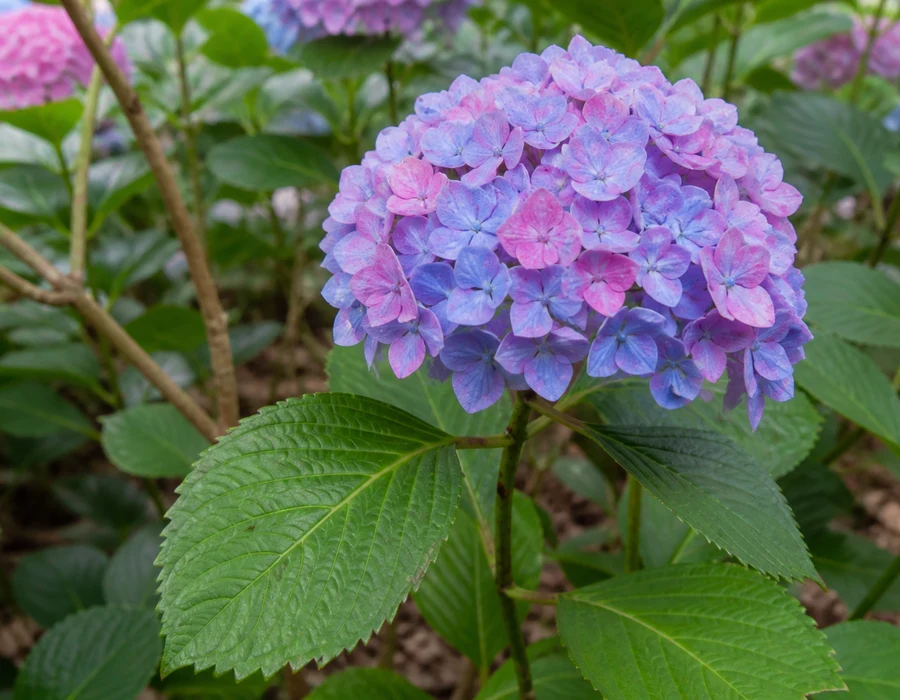
Hydrangea is a genus in the family Hydrangeaceae and contains many species. Identification begins with the whole shrub and its flower cluster, not with a blue or pink colour. Kew describes hydrangeas as shrubs, or occasionally small trees, with usually opposite serrated leaves and flower clusters at the ends of branches. A clear image of the cluster, individual flowers, a full leaf, and the overall plant can support a genus-level result.
| Trait | Hydrangea-group evidence | Why the trait helps |
|---|---|---|
| Growth habit | Usually a shrub, sometimes a small tree | The whole plant separates a woody hydrangea from a loose cluster on a non-woody plant. |
| Leaves | Usually opposite with serrated margins | Photograph two leaves at a stem node and one complete leaf. |
| Flower display | Terminal clusters containing many flowers | A close photo should show whether the display is rounded, flat, or elongated. |
| Individual flowers | Showy outer flowers and smaller fertile flowers can occur in the same cluster | A macro view helps distinguish a cluster from one large simple bloom. |
| Identification covered | Hydrangea species | Colour alone cannot identify a species or cultivar. |
Kew Plants of the World Online lists Hydrangea as the current genus name and describes its leaves and flower clusters. A photograph showing only one large rounded flower head may look like a hydrangea, but the leaves and shrub form are needed for a reliable genus-level identification.
Check a hydrangea in layers
- Start with the entire shrub. A woody shrub or small-tree habit carries more weight than a detached rounded cluster. Include the base and branching when the plant is accessible.
- Photograph one complete leaf pair at a node. The usual opposite, serrated leaves need to be seen where they join the stem. One loose leaf cannot confirm their arrangement.
- Read the cluster architecture. Decide whether the display is rounded, flatter with a distinct centre and edge, or elongated. That is the useful first step toward mophead, lacecap, or panicle terminology.
- Zoom in on individual flowers. A centre-and-edge close view can show the difference between small fertile flowers and larger showy flowers, a distinction that a distant cluster conceals.
- Use colour only after structure agrees. Blue, pink, purple, white, or greenish tones can help compare candidates, but they cannot name a cultivar or reveal soil conditions without knowing the hydrangea type.
This sequence makes the flower head part of a whole shrub rather than an isolated ball of colour. If the leaves are not opposite, the plant is not woody, or the cluster is built differently, keep the result at hydrangea-like and use the hydrangea resemblance guide to test alternatives.
Why Can Hydrangea Colour Change?
Colour change is not a universal hydrangea rule. The RHS hydrangea guide explains that the effect is most often seen in mophead and lacecap cultivars of Hydrangea macrophylla. RHS also names Hydrangea involucrata and Hydrangea serrata among the hydrangeas whose specified cultivars can change colour with soil acidity or alkalinity and aluminium availability.
For the applicable cultivars, flowers with an underlying blue or pink tendency can appear bluer in acid conditions with higher available aluminium, shift through mauve in slightly acidic to neutral conditions, and appear pinker in alkaline conditions. This is a species and cultivar-qualified observation. It does not identify an unknown hydrangea, and it does not mean every blue, purple, or pink flower changed because of soil.
Colour remains a supporting clue. A bloom may also look different as it opens or ages, and camera processing can change the recorded shade. First identify the flower-head form, individual flowers, leaves, and shrub. Consider soil-related colour change only when the species or cultivar is known to respond that way.
| Observed colour context | What the observation can support | What it cannot establish |
|---|---|---|
| Blue to purple tones in a relevant mophead or lacecap cultivar | A reason to check the cultivar-specific soil and aluminium explanation | The cultivar name, soil measurement, or a universal hydrangea rule |
| Mauve or mixed tones | A transitional-looking colour in a photograph | One fixed pH value or an identity from colour alone |
| Pink to red tones in a relevant cultivar | A reason to investigate soil-related colour change | The species, cultivar, or treatment history of the plant |
| White, green, or age-shifted flowers | A reminder that colour change is not the only source of variation | That the plant is or is not hydrangea |
Read the table from left to right: first confirm the plant and bloom-head type, then use colour as a qualified clue, then stop before turning that clue into a soil diagnosis. A photograph cannot measure soil acidity, aluminium availability, cultivar history, or the conditions under which the bloom developed.
Which Hydrangea Types Have Different Bloom Heads?
Hydrangea type terms describe visible flower-head patterns. They do not identify a species or cultivar by themselves. The two forms most often associated with Hydrangea macrophylla are mophead and lacecap, while other hydrangeas can produce elongated panicles or differently shaped clusters.
| Bloom-head term | Visible pattern | What it does not identify |
|---|---|---|
| Mophead | A round, tightly packed cluster with a full, ball-like appearance | Commonly used for selected cultivars, not every round flower cluster. |
| Lacecap | A flatter cluster with a central area of small fertile flowers and showier outer flowers | A close photo of the center and outer edge is needed. |
| Panicle | An elongated or conical cluster rather than a round head | The shape points to a different hydrangea type but does not settle a species from one image. |
The RHS distinguishes mophead, lacecap, and other shrubby hydrangea forms. A good photo includes the whole cluster and an individual flower near the center. Do not label a cultivar from a bloom-head shape alone.
Which Flowers Look Like Hydrangeas, and How Do You Tell Them Apart?
A hydrangea-like appearance usually begins with a large rounded or flattened cluster of many small flowers. That resemblance does not confirm Hydrangea. A photo may need the leaves, woody stems, cluster structure, and individual flowers to rule out another shrub or garden plant with a similar display.
Use flowers that look like hydrangeas when the cluster is the main clue and you need a focused set of alternatives. The resemblance page starts from visual shape. This page tests the hydrangea-group hypothesis with the shrub and leaf evidence that a cluster photograph can hide.
The strongest follow-up view is often a complete leaf at a stem node. Hydrangea leaves are usually opposite and serrated in Kew's genus description. A photo of two leaves at the same node, plus a full shrub view, can rule in or rule out the broad candidate more efficiently than another close-up of a showy cluster.
| Cluster or plant feature | Hydrangea guide | Lookalike guide |
|---|---|---|
| Rounded or flatter cluster on a woody shrub with opposite serrated leaves | Test the cluster centre and outer flowers, then keep the result at genus level until the evidence supports more | Open the hydrangea resemblance guide if the leaf pair or shrub habit conflicts |
| Flat or lacecap-like display with lobed leaves | Do not assume a hydrangea name from the cluster shape | Test a viburnum-type candidate through its cited card |
| Broad, loose spray of small flowers with compound leaves | The whole plant conflicts with the usual hydrangea leaf pattern | Test an elder-type candidate rather than transferring a hydrangea fact |
The reliable separator is not the most decorative flower cluster. It is the agreement between cluster architecture, individual flowers, leaf attachment, and woody habit. If that agreement is incomplete, keep the result hydrangea-like and request the node and whole-shrub views.
Why Does the Exact Hydrangea Name Matter?
The genus Hydrangea contains many species and cultivars. Flowering time, colour response, and pet-safety records for one hydrangea do not automatically apply to every member of the genus.
When and Where Do Hydrangeas Bloom?
Hydrangeas are native to parts of Asia, the Pacific, and the Americas. Because the genus contains many species growing in different climates, there is no single flowering season for every hydrangea.
Bigleaf hydrangea (Hydrangea macrophylla) is a commonly grown garden shrub. Its flower clusters usually have one of two shapes. Mopheads are round and densely packed. Lacecaps are flatter, with small flowers in the centre and larger showy flowers around the edge. The Royal Horticultural Society hydrangea guide uses the same mophead and lacecap terms. Its flowering calendar reflects UK growing conditions, so the flower shapes remain useful elsewhere but its months may not.
Do not apply UK flowering months automatically to hydrangeas growing elsewhere. Species, cultivar, climate, weather, and whether the plant grows outdoors or under protection can all change when it flowers. Use the flower bloom calendar to compare flowering periods that match the identified plant and location.
Are Hydrangeas Toxic to Cats, Dogs, or People?
The current ASPCA Hydrangea record identifies Hydrangea arborescens and lists that species as toxic to cats and dogs. The record does not establish the same verdict for every unresolved hydrangea image or every member of the genus.
| Question | Evidence-based answer |
|---|---|
| What scientific name does the current ASPCA hydrangea record name? | Hydrangea arborescens. |
| Does that record establish a verdict for every Hydrangea species? | No. The cited record applies to its named species. |
| What is needed before a pet-safety claim is shown? | A reliably identified scientific name and a current, cited animal-specific record. |
For a possible pet exposure or animal illness, contact a veterinary professional or an appropriate animal poison service promptly. Do not wait for photo analysis. Use the cat-safety directory or dog-safety directory to see the scientific name behind a cited result. This page does not provide treatment, dosage, or ingestion advice for people or animals.
Can a Photo Verify This Hydrangea?
A photo can support a hydrangea-group identification, but it should show more than a colorful flower cluster. Add a complete cluster, a close view of individual flowers, a leaf node showing the leaf pair, a full leaf edge, and the entire shrub. These views separate a genus-level candidate from a flower that only looks hydrangea-like.
Use the Flower Identifier to ask “Does this plant fit Hydrangea?” A careful result should explain which structures are visible, name a conflict or alternative when necessary, and ask for the leaf or full-shrub view that can reduce uncertainty. It should not turn a colour impression into a cultivar name, native-status claim, or generic pet-safety verdict.