Flowers Toxic to Dogs: A Cited Identification and Safety Guide
If your dog may have touched or eaten a flower, contact a veterinarian and an animal poison service immediately. This guide groups current ASPCA dog records by scientific name and places plants with the most serious reported signs first. A missing plant is not proof that it is safe.
This is a reference, not a diagnosis or treatment plan. A non-toxic row applies only to the named record and does not make an unidentified plant safe to eat.
Key takeaways
- For a suspected exposure, contact a veterinary professional or animal poison service without waiting for a photo result or symptom.
- Dog records are scientific name-specific, so a shared flower label cannot settle the safety question.
- A dog result does not transfer to another animal, including a cat.
- Keep the plant, label, and photographs, then check the current dog record with the professional.
Which Flowers Are Most Dangerous to Dogs?
The first rows cover plants whose dog records mention cardiac effects, shock, organ damage, death, or serious neurological and digestive signs. These include oleander, gloriosa lily, daffodil, tulip, hellebore, and amaryllis. Hydrangea, peony, Roman chamomile, dahlia, and Strelitzia reginae also have toxic dog records with different reported effects. ASPCA lists true Lilium lilies and Hemerocallis daylilies as non-toxic to dogs, but those dog results must not be applied to cats.
| Review order | Common names | Scientific name in the record | ASPCA dog result | Parts or signs named by the source | Source and date checked |
|---|---|---|---|---|---|
| Serious systemic-sign record | Oleander, rose-bay | Nerium oleander | Toxic to dogs | Cardiac glycosides; ASPCA lists drooling, abdominal pain, diarrhea, colic, depression, and death. This record is for oleander, not every plant called a rose. | ASPCA Oleander; accessed 2026-09-05. |
| Serious systemic-sign record | Gloriosa lily, glory lily, climbing lily, superb lily | Gloriosa superba | Toxic to dogs | ASPCA names salivation, bloody vomiting or diarrhea, shock, kidney and liver damage, and bone-marrow suppression. Do not transfer this record to a different plant sold as “lily.” | ASPCA Gloriosa Lily; accessed 2026-09-05. |
| Serious-sign record with bulb warning | Daffodil, narcissus, jonquil, paperwhite | Narcissus spp. | Toxic to dogs | Lycorine and other alkaloids; bulbs are the most poisonous part. ASPCA lists vomiting, salivation, and diarrhea, with large ingestions associated with convulsions, low blood pressure, tremors, and cardiac arrhythmias. | ASPCA Daffodil; accessed 2026-09-05. |
| Toxic record with bulb warning | Tulip, tulip bulb | Tulipa spp. | Toxic to dogs | Tulipalin A and B; ASPCA states that the bulb has the highest toxin concentration and lists vomiting, depression, diarrhea, and hypersalivation. | ASPCA Tulip; accessed 2026-09-05. |
| Toxic record with cardiac-glycoside warning | Christmas rose, hellebore, Lenten rose, Easter rose | Helleborus niger | Toxic to dogs | Cardiac glycosides, saponins, and protoanemonin; ASPCA lists drooling, abdominal pain, diarrhea, colic, and depression. | ASPCA Christmas Rose; accessed 2026-09-05. |
| Toxic record with alkaloid warning | Amaryllis, belladonna lily, Jersey lily, naked lady | Amaryllis spp. | Toxic to dogs | Lycorine and other alkaloids; ASPCA lists vomiting, depression, diarrhea, abdominal pain, hypersalivation, anorexia, and tremors. | ASPCA Amaryllis; accessed 2026-09-05. |
| Toxic record with gastrointestinal signs | Hydrangea, hortensia, Hills of Snow, seven bark | Hydrangea arborescens | Toxic to dogs | Cyanogenic glycoside; ASPCA lists vomiting, depression, and diarrhea. The named record is for H. arborescens, not an automatic verdict for every cultivated hydrangea. | ASPCA Hydrangea; accessed 2026-09-05. |
| Toxic record with gastrointestinal signs | Peony | Paeonis officinalis | Toxic to dogs | Paeonol; ASPCA lists vomiting, diarrhea, and depression. The record's named scientific name does not establish a verdict for every plant sold under peony. | ASPCA Peony; accessed 2026-09-05. |
| Toxic record with irritant or gastrointestinal signs | Roman chamomile, chamomile, garden chamomile, ground apple | Anthemis nobilis | Toxic to dogs | Volatile oils; ASPCA lists contact dermatitis, vomiting, diarrhea, anorexia, and allergic reactions. Anthemis nobilis is a synonym used for Roman chamomile, Chamaemelum nobile. | ASPCA Roman Chamomile; accessed 2026-09-05. |
| Toxic record with mild signs | Dahlia, many varieties | Dahlia species | Toxic to dogs | ASPCA lists mild gastrointestinal signs and mild dermatitis. This is a genus-level record and does not identify a particular cultivar from a photograph. | ASPCA Dahlia; accessed 2026-09-05. |
| Toxic record with fruit and seed warning | Bird's tongue flower, bird of paradise flower, crane flower | Strelitzia reginae | Toxic to dogs | ASPCA lists mild nausea, vomiting, and drowsiness, mainly from fruit and seeds. It warns that “bird of paradise” can also describe more toxic Caesalpinia or Poinciana gilliesii plants. | ASPCA Bird's Tongue Flower; accessed 2026-09-05. |
| ASPCA non-toxic dog record | Rose, garden rose | Rosa species | Non-toxic to dogs | ASPCA lists the named Rosa record as non-toxic. It does not cover rosebay, Christmas rose, desert rose, or another common-name plant. | ASPCA Rose; accessed 2026-09-05. |
| ASPCA non-toxic dog record | True lily and named garden lily groups | Lilium species | Non-toxic to dogs | ASPCA lists this true-lily record as non-toxic to dogs. Keep the genus boundary visible: peace lily, calla lily, lily of the valley, and daylily are separate records. | ASPCA Lily; accessed 2026-09-05. |
| ASPCA non-toxic dog record | Daylily and many daylily varieties | Hemerocallis spp. | Non-toxic to dogs | ASPCA lists the daylily record as non-toxic to dogs. This is a separate genus from Lilium, and the result must not be carried to an unidentified “lily.” | ASPCA Day Lilies; accessed 2026-09-05. |
The ASPCA toxic and non-toxic plant database covers many commonly encountered plants, but it is not a complete list. Use a record only when its scientific name matches the plant and it specifically applies to dogs. A missing entry does not prove that a plant is safe. If exposure is suspected, keep the plant, label, and photographs available for a veterinarian and follow the urgent advice above.
How Do You Check an Unknown Flower Safely?
Use these steps while contacting a professional:
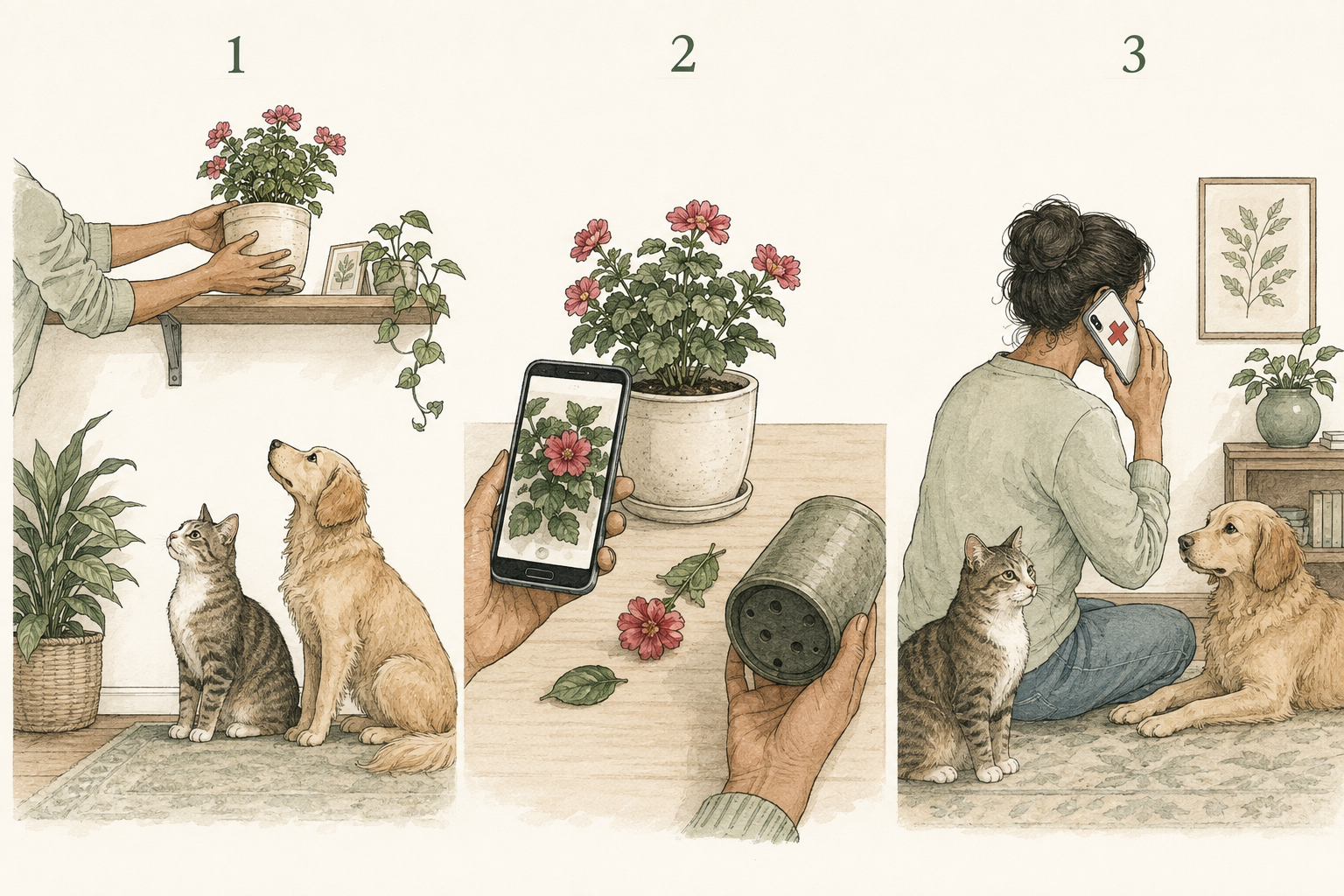
- Create distance without disturbing the sample. Move the dog away from the bouquet, plant, fallen leaves, bulb, or vase water if you can do that safely. Keep the original material available for a professional.
- Record the context. Photograph the whole plant, the flower face and side, leaves, stem, label, and any plant part that may be involved. Write down the common name exactly as printed, where it was obtained, the time of contact, and the part that may have been chewed.
- Identify the plant. Compare the flower, leaves, stem, bulb, and whole plant with a botanical reference. A photograph may identify only the genus or a broader group.
- Check the dog record. Open the source linked in the table and confirm its scientific name, plant-part notes, and listed signs. If the scientific name does not match, do not use the result. Contact a veterinarian or animal poison service immediately.
Do not taste, crush, brew, or rub an unknown sample on skin to obtain a better clue. These steps help preserve information a professional may need. A photo identification cannot declare an exposure safe, and the absence of symptoms does not prove safety.
Why Can the Same Flower Have Different Records for Dogs and Cats?
Plant-safety records apply to a named plant, a particular animal, and sometimes a particular plant part. A dog record therefore cannot be used for a cat. In the ASPCA records cited here, true lilies in Lilium and daylilies in Hemerocallis are listed as non-toxic to dogs. Separate cat records carry an urgent kidney-risk warning. Never combine those results or transfer one animal's record to another.
The FDA's lily guidance and the Merck Veterinary Manual provide a cross-check for the feline kidney-risk relationship, while the dog result remains the ASPCA dog record linked in this table. Other examples also depend on exact identity: Rosa has a non-toxic dog record, but oleander, Christmas rose, and desert rose are different plants despite sharing a rose word. The same rule applies to peace lily, calla lily, and lily of the valley.
ASPCA describes its database as a guide to frequently encountered plants rather than a complete inventory. A missing dog entry, a partial photo, or an ambiguous common name cannot settle the question. If the plant's scientific name is uncertain, keep the plant, label, and photographs available and contact a veterinarian or animal poison service. Use the separate cat-safety directory when the affected animal is a cat.
Which Flower Guides Have Current Dog-Safety Records?
The following flower guides link to dog-safety records with matching scientific names:
- True lily maps to ASPCA's non-toxic dog record for Lilium species. Keep daylily and non-Lilium lily names separate.
- Rose maps to ASPCA's non-toxic dog record for Rosa species. The result does not cover rosebay or desert rose.
- Peony maps to ASPCA's toxic dog record for Paeonis officinalis.
- Hydrangea maps to ASPCA's toxic dog record for Hydrangea arborescens, with vomiting, depression, and diarrhea named by the source.
- Roman chamomile maps to ASPCA's Anthemis nobilis synonym record, which is toxic to dogs.
- Bird of paradise maps to the Strelitzia reginae bird's tongue flower record, which is toxic to dogs with mild signs mainly associated with fruit and seeds.
No matching current ASPCA dog record is shown here for dandelion, common daisy, or the aster groups in this site. Their absence does not prove safety. For any suspected exposure, follow the urgent advice at the top of this page.